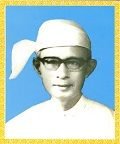
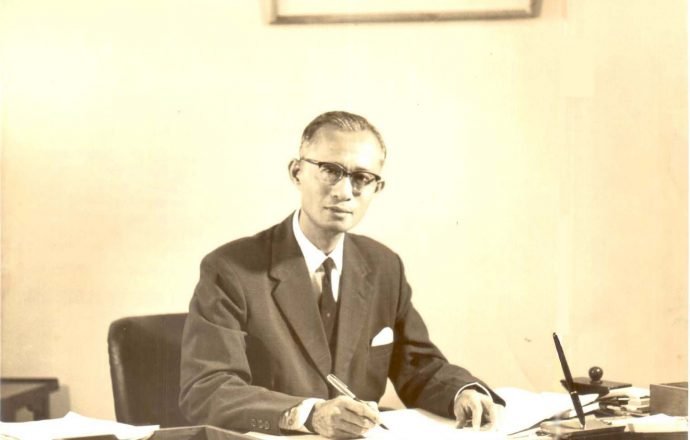
In the mid-20th century, as newly independent Asian nations emerged from decades of colonial rule, the continent faced a daunting challenge: vast geographical distances, fragmented infrastructure and deep Cold War geopolitical divides. Amid this complex landscape, Sithu U Nyun—a Myanmar development economist and diplomat—became one of the premier architects of Asian regional integration.
As Executive Secretary of the United Nations Economic Commission for Asia and the Far East (ECAFE, later ESCAP) from 1959 to 1973, U Nyun spearheaded ambitious regional projects, most notably the Asian Highway Network.
The Vision: Reconnecting an Entire Continent
In 1959, under U Nyun’s leadership, ECAFE launched the Asian Highway project. The objective was grand: revive ancient land routes—akin to a modern Silk Road—by standardizing and linking existing highway systems into a continuous transport network spanning tens of thousands of kilometers from Türkiye and the Middle East to South-East Asia.
The project aimed to achieve several key outcomes:
- Facilitate Regional Trade & Mobility: Connect landlocked countries to major ocean ports, lower transport costs and drive cross-border commerce.
- Post-Colonial Economic Integration: Foster economic self-reliance among Asian nations rather than relying solely on former colonial trade channels.
- Promote Peace through Contact: Build physical bridges between neighbors to encourage cultural exchange, tourism and mutual understanding.
U Nyun’s Critical Role & Diplomatic Strategy
Building a cross-border road system during the Cold War was an immense challenge. Tensions ran high between communist and non-communist states, and many governments lacked financial resources. U Nyun’s leadership made the vision actionable through key strategies:
1. The “Asian Way” of Pragmatic Consensus
U Nyun pioneered a diplomatic approach often called the “Asian Way”—focusing on informal consensus, mutual respect and non-confrontational dialogue over rigid Western-dominated frameworks. By insulating infrastructure development from political rivalries, he persuaded countries with delicate or hostile diplomatic relationships to sit at the same negotiating table under UN auspices.
2. Practical, Low-Cost Standards
Recognizing that member nations could not afford brand-new transcontinental expressways, U Nyun established a realistic policy: maximize existing national infrastructure. Instead of requiring countries to build expensive new roads, ECAFE designated priority national routes, agreed on uniform design and safety standards and focused resources on filling missing cross-border links.
3. A Holistic Vision of Regional Development
U Nyun understood that roads alone were not enough. He recognized that regional trade required financial backing and coordinated resource management. As a result, he simultaneously championed other foundational regional institutions:
- The Asian Development Bank (ADB): Founded in 1966 under his leadership (earning him the title “Father of the Asian Development Bank”) to finance major infrastructure projects like highways, ports and power grids.
- The Mekong River Project: Mobilizing multilateral cooperation for hydropower, irrigation and navigation along the Lower Mekong Basin across Cambodia, Lao PDR, Thailand and South Viet Nam.
Legacy of the Asian Highway Network
During U Nyun’s tenure (1960–1970), the Asian Highway Network saw remarkable progress, completing feasibility studies, unifying route classifications (such as Route A-1 and Route A-2), and establishing the momentum for regional transport.
Though political instability in the mid-1970s temporarily slowed progress, the project regained strong momentum in the 1990s and 2000s under ESCAP. Today, the Asian Highway Network spans over 140,000 kilometers across 32 countries, serving as a cornerstone of trade, supply chains and land transport across Asia and Europe.
U Nyun’s legacy endures in the physical linkages connecting millions of people across the continent, proving that pragmatic cooperation can transcend geopolitical boundaries.